

Denial pressure
Denied claims stack up while the team stays busy submitting today's work. Without a clear owner and a root-cause loop, the same denials repeat.
Medical billing & RCM
Medbilling RCM runs claims, denials, coding, AR follow-up, and payer reconciliation for physician groups, hospitals, and ambulatory surgery centers, inside the systems you already use. No EHR migration.
Book a free revenue assessment. We review 90 days of your claims, denials, and AR aging, then send a written breakdown of where revenue is leaking, before you commit.

The gap
Fragmented billing is not only a staffing problem. It is a systems problem. The gap between services delivered and cash collected widens quietly.

Denied claims stack up while the team stays busy submitting today's work. Without a clear owner and a root-cause loop, the same denials repeat.

Aged balances drift past filing windows when follow-up is squeezed by same-day volume. Leadership often sees the pile after it is already expensive to work.

When CFOs and administrators rely on month-old summaries, denial patterns and payer shifts surface too late to course-correct in the current cycle.

Code updates and payer rule changes land across coding, credentialing, and claim edits. Left unmanaged, small misses compound into write-offs and audit exposure.
Measurement literacy
A clean claim rate can be measured at two different points, and the two figures are not close.

Point A
Clearinghouse acceptance confirms the claim was formatted correctly, no missing zip code, no malformed field. The payer can still reject it on eligibility, authorization, or medical necessity the moment it arrives.
Point B
Payer first-pass yield means the claim was accepted for processing (and, on a strict definition, paid without rework). Clearinghouse acceptance commonly runs higher than payer first-pass yield, so the same billing operation can honestly report two very different numbers depending on which point it counts.
Ask any billing company which point they count from before you compare figures side by side.
Operating model
We build the workflow before we automate volume. Eligibility checks, claim scrubbing, and remittance posting can run at scale once the process is sound. Appeals that need a clinical argument stay with specialists. So do contract issues, and denial patterns that only look random until someone who knows that payer recognizes them.
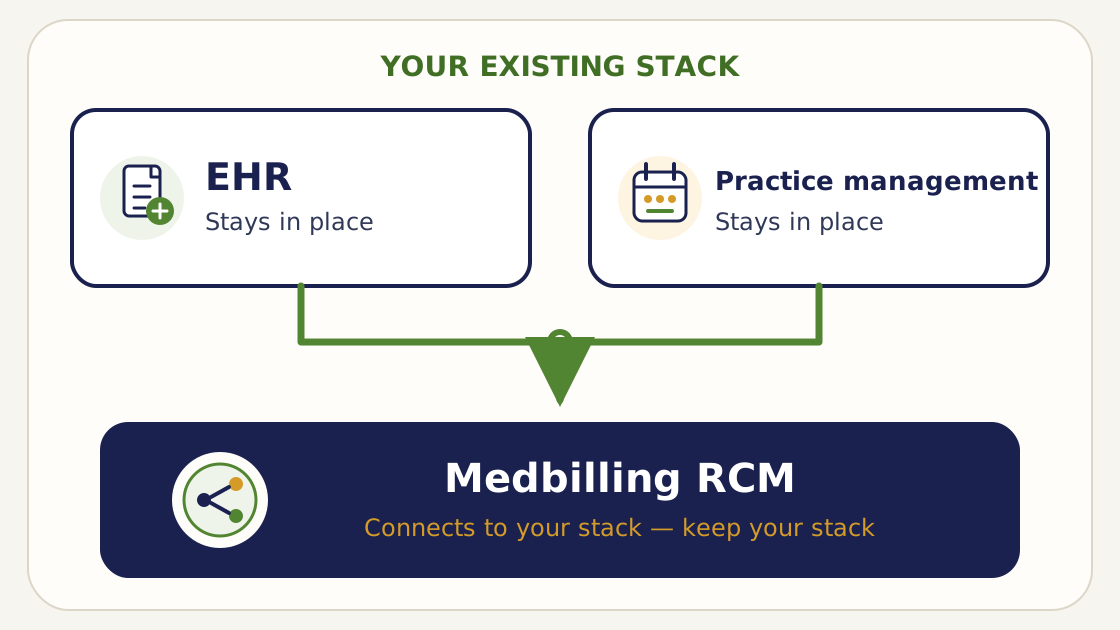
This is outsourcing inside your stack, not a platform rip-and-replace. We work with your existing EHR and practice management setup so groups and hospitals are not forced into a migration to improve billing operations.

Coverage
Medical billing management works when the pieces connect. Coding informs denial prevention. Denial patterns inform follow-up priorities. AR data shows where documentation support is needed. Run as disconnected tasks, each piece underperforms.
Method
Five phases Medbilling RCM uses to move a practice from diagnosis to steady-state performance.
Diagnose the current cycle before changing anything. Identify leakage points and set KPI baselines.
Build workflows, integrations, coding protocols, and payer mapping around how your organization actually runs.
Stand up operations without replacing your clinical systems.
Claims optimization, denial resolution, and AR pursuit on a set cadence, not whenever someone finds time.
Recurring leadership reporting and payer performance review so gains compound.


Qualification
Understanding fit early saves everyone time.
FAQ
No. Engagements are built to work with the systems you already run. This is keep-stack outsourcing, not a platform migration project.
A review of about 90 days of claims, denials, and AR aging, with written findings on E/M distribution, top denials by dollar, and aged AR by payer. You keep the findings whether or not you work with us.
Ask which measurement point is used: clearinghouse acceptance versus payer first-pass. The two are not interchangeable. See the measurement section above.
Specialty-assigned workflows are part of the model. See specialties for depth; the assessment confirms fit for your payer mix.
Engagements are scoped during the revenue assessment based on size, specialty mix, and service scope, not a one-line public rate card on this page.
Next step
We review about 90 days of your claims, denials, and AR aging. You receive a written view of your E/M distribution, top denial reasons by dollar, and aged AR by payer.