FQHC billing services for federally qualified health centers
Every unbilled FQHC visit is revenue your center won't get back. As an FQHC medical billing company, Medbilling RCM checks each visit for qualification before the claim goes out. When a Medicaid managed care plan pays less than your PPS rate, we file for the wraparound. We take on Section 330 grantees and FQHC look-alikes in all 50 states. We can run your full billing operation or support your in-house team.
How We're Different
FQHC billing that separates PPS from fee-for-service
Most billing companies are built for fee-for-service. Your Medicare and Medicaid revenue runs on qualifying visits instead. Medicare pays 80% of the lesser of your charge or the PPS rate. CMS adjusts that rate for your area and for new patient or wellness visits. CMS set the CY 2026 base rate at $207.72 in CR 14309, up 2.5% from $202.65. Miss a visit and you don't get a reduced payment. You get nothing. Each Medicare visit needs a G0466 to G0470 code and a qualifying line, both under revenue code 052X or 0900.
CY 2026 base rate
$207.72
up 2.5% from $202.65
Set by CMS in CR 14309
What We Handle
Six FQHC billing services that protect every encounter payment
Each one covers a step in the encounter cycle, from qualification to reconciliation.
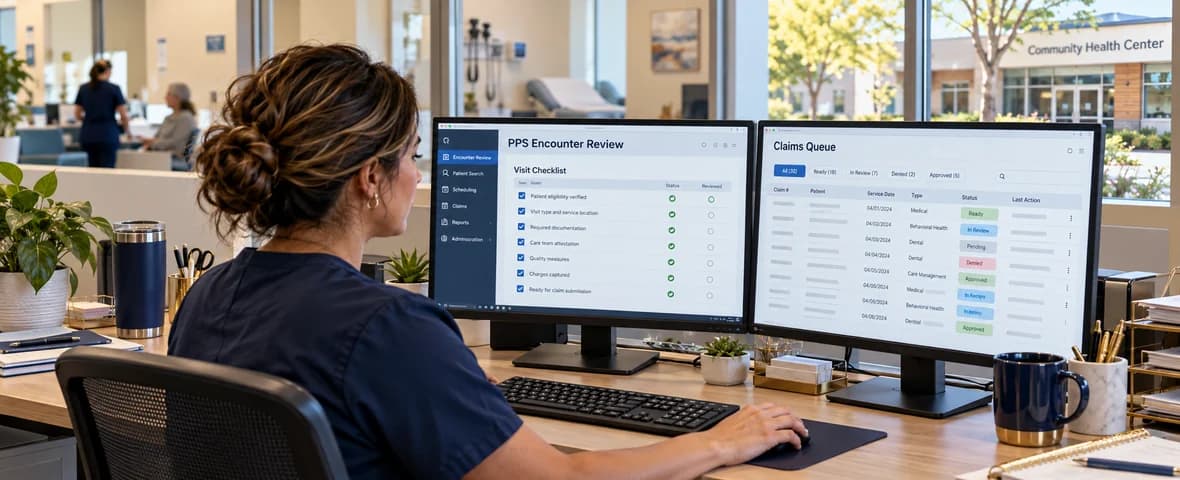
Every billable encounter found and filed
Before each claim goes out, we check who saw the patient and why the visit was necessary. Qualifying makes it billable, but it doesn't guarantee payment.
Same-day medical and mental health visits
Medicare pays a same-day medical visit and a mental health visit as two encounters. We report the mental health visit with G0470 under revenue code 0900.
Each wraparound gap reconciled and filed
We reconcile each Medicaid MCO payment against your PPS rate and file the gap where your state requires. Recovery depends on state rules and filing limits.
Sliding fee discounts documented for HRSA
Income records drive each discount under HRSA's sliding fee discount program. Patients at or below 100% FPL get either a full discount or a nominal charge.
Denied claims traced and refiled correctly
We trace each denial to the code or note that caused it, then refile within filing limits. Every balance still open moves to accounts receivable recovery.
Encounter data aligned with UDS reporting
Your annual Uniform Data System report should match what you bill and collect. We flag any gaps between the billing and clinical counts before UDS season.
How We Start
Five steps from signed BAA to monthly FQHC reporting
Engagements follow five steps. We'll size the work and reporting to your visit volume.
Sign your BAA, confirm system access
Nothing moves until the BAA is signed, then we document scope and reporting.
Audit your encounter and denial data
We measure encounter capture and denial patterns by payer, plus your open A/R.
Map payers against your Medicaid rules
We confirm each payer's PPS or APM rate and filing deadlines before billing.
Submit claims and file for shortfalls
Medicare and Medicaid PPS claims run in one workflow with commercial and CHIP.
Report monthly on capture and denials
Your report tracks capture rate and denials, plus wrap status and A/R aging.
Day One
What your health center gets from Medbilling RCM
Here's what you get from day one.
- BAA signed before any data moves
- $0 setup fee and 5-day onboarding
- No long-term contract is required
- BBB A+ and Accredited since 2025
- Payments land in your own account
- PPS rates checked at their source
- Wrap shortfalls tracked and filed

Common Questions
What health centers ask before outsourcing FQHC billing
Short answers to what FQHC finance teams ask us most.
How does PPS billing differ from fee-for-service?
FQHC PPS billing pays one rate per qualifying visit. Fee-for-service pays for each service you bill. Medicare FQHC claims also go on the institutional 837I with type of bill 77X. A team that's only worked fee-for-service tends to miss qualifying visits or code them wrong.
What qualifies as a billable encounter?
It's a medically necessary medical or mental health visit with an FQHC practitioner. That includes everyone from physicians and NPs to clinical social workers. Nurse-only visits and lab draws usually don't count. Some mental health visits by real-time telehealth also count. Qualification still depends on documentation and payer rules.
How do you handle FQHC wraparound billing?
A wraparound covers the gap when a Medicaid managed care plan pays below your PPS rate. By default your state pays it, though some states make the plan pay instead. We'll match every MCO payment to your rate and file wherever your state requires. Recovery isn't guaranteed. But an unfiled shortfall is money you'll never see.
Why do FQHC claims get denied?
Medicare won't pay a PPS visit claim that lacks a G0466 to G0470 code and a matching qualifying visit line. Unenrolled practitioners and incomplete encounter documentation also stop payment. We trace each denial to its cause before we refile within the payer's deadline.
Do you handle provider credentialing?
Yes. Our credentialing and enrollment team checks PECOS and Medicaid enrollment for each practitioner before claims go out. A new practitioner at your center can't bill encounters until each payer enrolls them. We'll confirm the exact credentialing scope with you during onboarding.
Ready When You Are
See where your center's revenue gets stuck
Our FQHC billing services start with a free review of your encounter capture and open wraparound claims. You keep the findings either way.
- Encounter capture reviewed
- Open wraparound claims assessed
- You keep the findings either way
Get a Free Revenue Assessment
For Section 330 grantees and FQHC look-alikes. All 50 states.
HIPAA Compliant | BAA On Day One | Google Reviews | BBB Accredited Business